
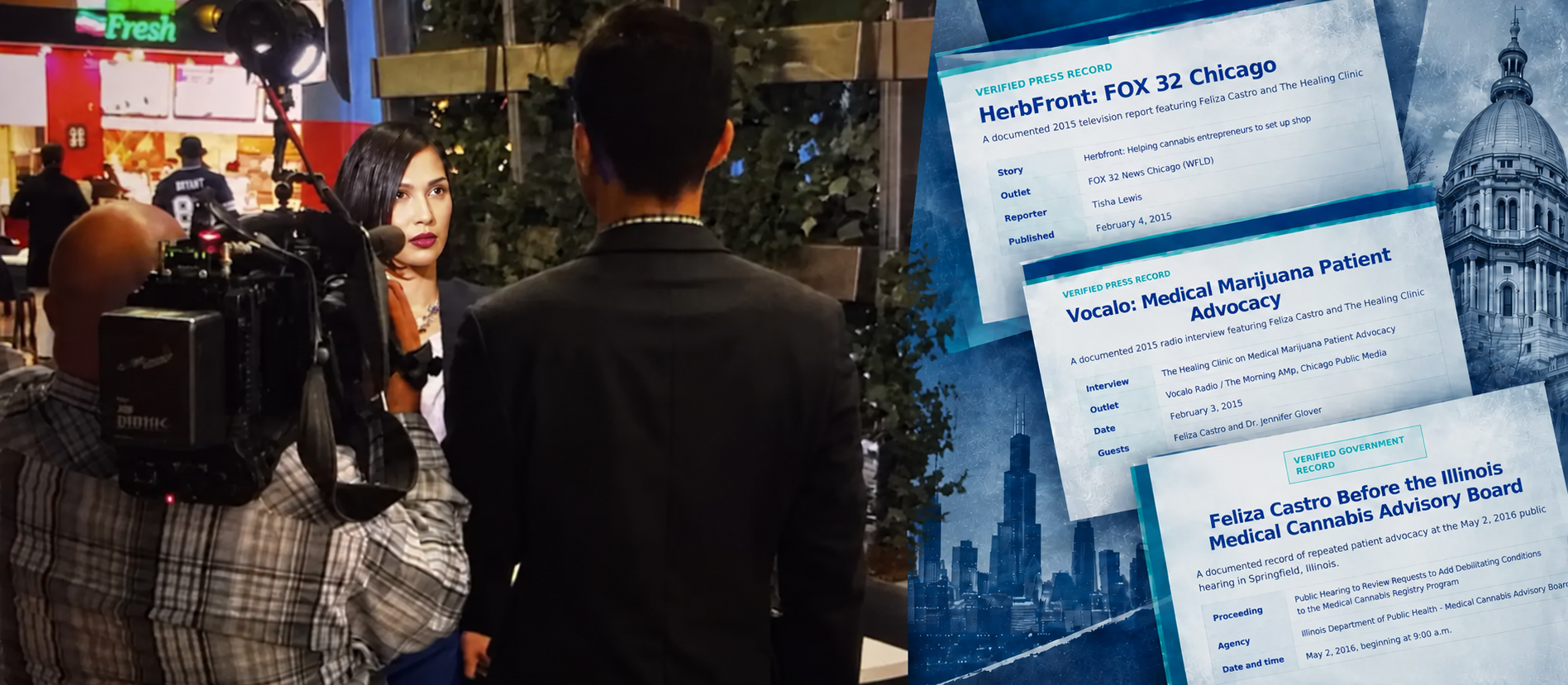
When mainstream media covered the emergence of Illinois’s legal cannabis market, much of the attention followed capital: corporate operators, real-estate owners and political permit-holders—the “suits” securing licenses and storefronts.
“But storefronts do not create a medical market. Patients do.”
As a single mother in her twenties, Feliza Castro built the grassroots patient infrastructure that helped make the Illinois Medical Cannabis Pilot Program viable. As the sole owner of The Healing Clinic, she financed the organization entirely herself—without corporate backing or outside investors.
Feliza established and staffed three clinics in Chicago, Highland Park and Flossmoor. The Healing Clinic contracted with physicians who certified patients and employed patient advocates who helped Illinois residents navigate one of the country’s most restrictive medical cannabis registration systems. The clinic’s physicians and advocates helped more than 10,000 patients obtain their medical cannabis cards.
While headlines concentrated on property, permits and investment, Feliza and her team were doing the difficult work on the ground: educating patients, building medical support, advocating before state decision-makers and helping Illinois residents gain lawful access to treatment.
This archive restores that missing part of the record. Through television coverage, radio interviews, official government transcripts and contemporaneous reporting, it preserves the work of an independent, self-funded Latina entrepreneur who helped build the patient foundation beneath Illinois’s emerging cannabis industry.
The Coverage
High-stakes legislative testimony and on-site news interviews at Chicago’s James R. Thompson Center document Feliza Castro’s effort to expand Illinois’s highly restrictive medical cannabis program.
The Impact
Speaking from her personal experience living with lupus, Feliza publicly advocated for chronic pain and anxiety to be added to Illinois’s list of qualifying conditions—bringing attention to patients excluded under the original law.
“There are no harsh or negative physical reactions that our patients are seeing, because cannabis is nontoxic and it is natural. It is something that our bodies are actually hard wired to receive and work with.”
Feliza Castro · WTTW Chicago Tonight
The Coverage
FOX 32 Chicago reporter Tisha Lewis examines the effort to expand Illinois’ medical cannabis qualifying conditions. Feliza Castro discusses her experience as a patient and the petition process facing people excluded from the program.
The Impact
The segment connects policy debate to the people living with its consequences. Castro brings patient advocacy into the public conversation, explaining why the opportunity to be heard matters to those still waiting for access.
Explore The Healing Clinic’s petition advocacy →
“I did attend the Medical Cannabis Advisory Board hearing last week, and I asked them firsthand, ‘Realistically, how long will it be until we see conditions added to the law?’ And they said, ‘About 12 months.’”
Feliza Castro · FOX 32 Chicago
The Coverage
In this intimate Chicago Tribune interview, Feliza Castro moves beyond policy and speaks candidly about her own journey with lupus and anxiety. She describes how medical cannabis brought relief, perspective and a renewed sense of well-being—and how that personal experience inspired the patient-centered model behind The Healing Clinic.
The Impact
Castro transformed private struggle into public service. The Healing Clinic gave patients more than help navigating Illinois’ new system: it offered a place where people living with chronic illness, anxiety and daily uncertainty felt seen and understood. By pairing practical guidance with empathy and a dedicated team of advocates, Castro helped replace isolation with relief—and built the human foundation beneath a new medical cannabis program.
“That’s really what we provide here—a sense of understanding for these patients and what they are going through and their daily struggles. We have a team of advocates to say, ‘We’re here, we understand, and we are here if you need anything in the future.’ It creates this sense of relief, like finally, somebody understands me.”
Feliza Castro · Chicago Tribune